
Key Takeaways
- The core lessee model is the same. Both standards require recognising a right-of-use asset and lease liability on the balance sheet
- FRS 102 uses "obtainable borrowing rate" instead of "incremental borrowing rate". Same concept, different name
- FRS 102 provides more explicit guidance on which assets qualify for the low-value exemption
- Both standards allow a simplified (modified retrospective) transition, and FRS 102 entities benefit from IFRS 16 lessons learned
- If you understand one standard, you largely understand the other. The differences are narrow and specific
Overview
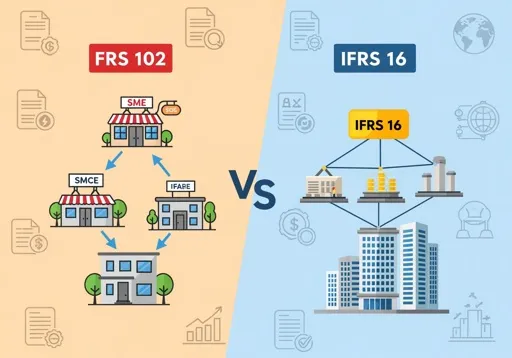
When the Financial Reporting Council (FRC) revised Section 20 of FRS 102, the explicit goal was to align the lessee accounting model with IFRS 16. The result is two standards that are substantially similar, sharing the same principles, the same measurement approach, and the same balance sheet outcome.
However, "aligned" does not mean "identical". There are specific differences in terminology, guidance, and scope that finance teams need to understand, particularly those operating in groups that report under both standards, or teams transitioning from IFRS 16 experience to FRS 102 compliance.
This guide covers every material difference, organised by topic. Where the standards are the same, we say so briefly and move on.
Side-by-Side Comparison
| Topic | FRS 102 (Section 20) | IFRS 16 |
|---|---|---|
| Effective date | Periods beginning on or after 1 January 2026 | Periods beginning on or after 1 January 2019 |
| Issuing body | Financial Reporting Council (FRC) | International Accounting Standards Board (IASB) |
| Applies to | UK and Ireland entities not required to use full IFRS | Publicly accountable entities and those that elect to apply full IFRS |
| Lessee model | Single model: ROU asset + lease liability | Single model: ROU asset + lease liability |
| Lessor model | Dual model: operating/finance lease classification | Dual model: operating/finance lease classification |
| Discount rate terminology | Obtainable borrowing rate | Incremental borrowing rate (IBR) |
| Discount rate determination | Same approach: rate to borrow for similar term, security, and value | Same approach |
| Portfolio discount rate | Explicitly permitted | Permitted as a practical expedient |
| Short-term lease exemption | Available (12 months or less at commencement) | Available (12 months or less at commencement) |
| Low-value lease exemption | Available, with explicit examples of included and excluded assets | Available, with general guidance only (approx. US$5,000 when new) |
| Lease identification | Same definition: contract conveys right to control use of an identified asset | Same definition |
| Initial measurement | Same: PV of lease payments + adjustments | Same |
| Subsequent measurement | Same: interest on liability, depreciation on ROU asset | Same |
| ROU asset revaluation | Not explicitly addressed | Permitted if entity applies revaluation model to that class of PPE |
| Modifications | Same approach: remeasure liability, adjust asset | Same approach |
| Sale and leaseback | Addressed, aligned with IFRS 16 principles | Detailed guidance in IFRS 16.98–103 |
| Transition options | Simplified (modified retrospective) | Modified retrospective or full retrospective |
| Disclosure requirements | Aligned with IFRS 16 but slightly less extensive for smaller entities | Comprehensive disclosure requirements |
Key Differences in Detail
1. Discount Rate Terminology
FRS 102 uses the term "obtainable borrowing rate" where IFRS 16 uses "incremental borrowing rate" (IBR). Despite the different names, the definition and practical determination are the same: the rate the lessee would have to pay to borrow over a similar term, with similar security, to obtain an asset of similar value in a similar economic environment.
In practice: If you have already determined IBRs for IFRS 16 purposes (e.g. at group level), the same methodology applies for FRS 102. The rate is entity-specific and date-specific, so subsidiary rates may differ from the group rate. For a practical, step-by-step approach to determining the OBR, including methods for entities without a credit rating, see our FRS 102 discount rates guide.
2. Low-Value Lease Exemption
Both standards offer a low-value lease exemption, but FRS 102 is more prescriptive about what qualifies:
| Aspect | FRS 102 | IFRS 16 |
|---|---|---|
| Value threshold | No specific monetary threshold, but guided by examples | Approximately US$5,000 when new (IASB basis for conclusions) |
| Explicitly included | Office furniture, small printers, laptops, tablets, telephones | General guidance only. Similar examples given in basis for conclusions |
| Explicitly excluded | Vehicles, construction equipment, farming equipment, boats, ships | Cars are excluded (basis for conclusions), less specific on other assets |
| Election basis | Lease-by-lease | Lease-by-lease |
This additional specificity in FRS 102 is helpful for smaller entities that may not have the resources to make detailed judgements about asset values.
3. ROU Asset Revaluation
IFRS 16 allows entities to revalue right-of-use assets if they apply the revaluation model to the relevant class of property, plant, and equipment (IAS 16). FRS 102 does not explicitly address ROU asset revaluation, meaning the cost model is the expected treatment.
This difference is primarily relevant for property-heavy entities. In practice, few entities revalue ROU assets even under IFRS 16, so the practical impact is limited.
4. Disclosure Requirements
Both standards require substantial disclosures, including maturity analyses, movement schedules, and qualitative information about leasing activities. However, FRS 102's disclosure requirements are slightly less extensive, reflecting its audience of smaller entities.
The core disclosures are the same:
- ROU asset values by class of underlying asset
- Lease liability carrying amounts
- Interest expense and depreciation charges
- Short-term and low-value lease expenses
- Total cash outflow for leases
- Maturity analysis of undiscounted lease payments
For detailed disclosure guidance, see our IFRS 16 disclosure requirements guide. The principles translate directly.
5. Transition Timing
IFRS 16 has been in effect since January 2019, giving entities seven years of implementation experience. FRS 102 entities transitioning in 2026 have the significant advantage of learning from this track record. Common pitfalls, best practices, and audit expectations are well documented.
Leverage IFRS 16 Experience
If your group or advisors have been through an IFRS 16 implementation, apply that experience directly. The transition mechanics, data requirements, and system needs are the same. You'll avoid the trial-and-error that characterised many early IFRS 16 adoptions.
Where They're the Same
It's worth emphasising how much is identical between the two standards. For the following topics, you can use IFRS 16 guidance directly:
Our IFRS 16 guide and its sub-guides on lease liability, right-of-use assets, discount rates, and journal entries all apply directly to FRS 102.
Groups Reporting Under Both Standards
Some groups prepare consolidated accounts under IFRS but have subsidiaries that file individual statutory accounts under FRS 102. In these cases:
- The group already complies with IFRS 16 at the consolidated level
- Each FRS 102 subsidiary must also apply the revised Section 20 for its own statutory accounts
- The lease data and calculations can largely be reused, as the underlying model is the same
- The main difference is the discount rate, which must be entity-specific (the subsidiary's obtainable borrowing rate may differ from the group's IBR)
Practical Tip for Groups
If you already use lease accounting software for IFRS 16, the same system can typically handle FRS 102 reporting with minimal additional configuration. Rubli supports both standards within a single platform, allowing group and subsidiary reporting from the same lease data.
This article is provided for general informational purposes only and does not constitute accounting, legal or professional advice.